
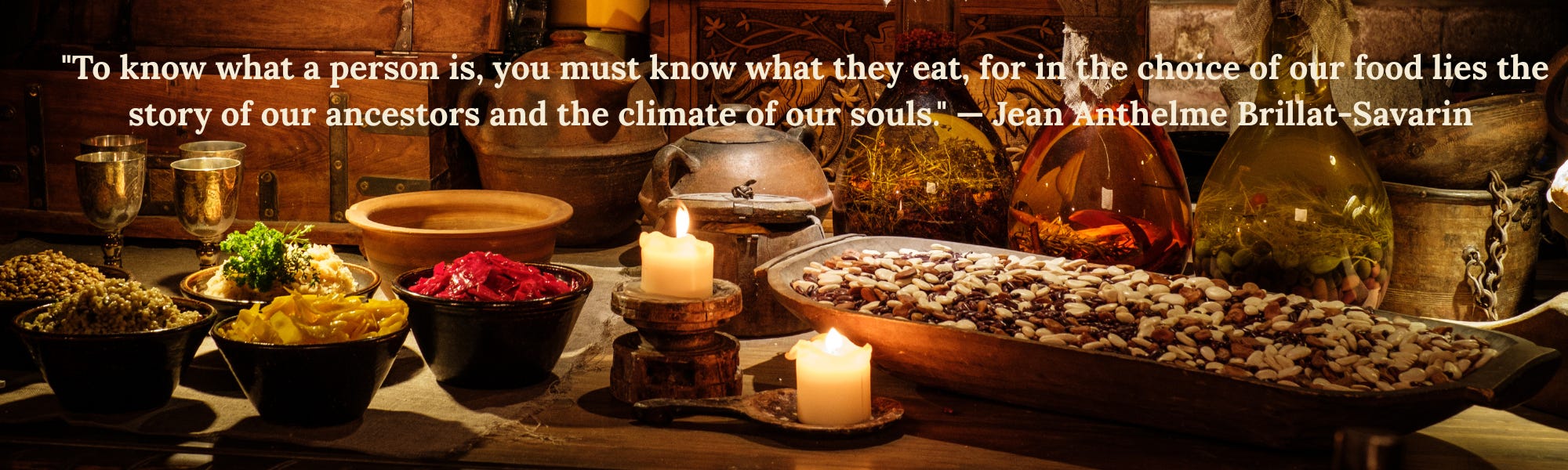
The harvest festival lasts three days. On the first, the grain is blessed and the the community sings the old songs that remember the Famine Years, when the rivers went silent and the fields turned to dust. On the second, the feasting begins in earnest: roasted meats, honey cakes, the first pressing of the season’s wine. On the third day, a portion of everything is burned to give back to the land and the gods.
Food is never just food. Across every human culture that has ever existed, the act of eating and the fear of not eating has generated some of the richest symbolic, spiritual, and political systems our species has ever devised. What a culture eats, how it obtains food, who controls the surplus, and what rituals surround the table all speak volumes about that culture’s values, its history, and its relationship to the natural and supernatural world.
For world-builders, food is one of the most underused and most powerful tools in the craft. A culture’s cuisine is a fingerprint. It tells us about the climate, the trade routes, the theology, the class system, and the collective memory of catastrophe. A world where salt is taxed like gold feels different from one where spices are democratized by a mage-guild’s preservation magic. A culture that burns part of every feast for its ancestors lives differently than one that does not.
This issue explores the deep relationship between cultures and sustenance, drawing on anthropology, history, and agricultural science to give you practical tools for building food cultures that feel real, layered, and alive.
