
The old man points to the ruins beyond the wheat fields with cracked columns, a lintel carved with figures no one can name and says the same thing he always says: they were greater than us. His grandson has heard it a hundred times. By the time the boy is old, he will say it too, pointing at different ruins, meaning the same thing.
Every culture in recorded history has told some version of the same story: once, the world was better. The people were stronger, wiser, closer to the gods, or simply luckier. Then something broke and the world has been declining ever since. Historians call this the myth of the Golden Age. It is one of the oldest, most persistent, and most politically potent ideas in human thought.
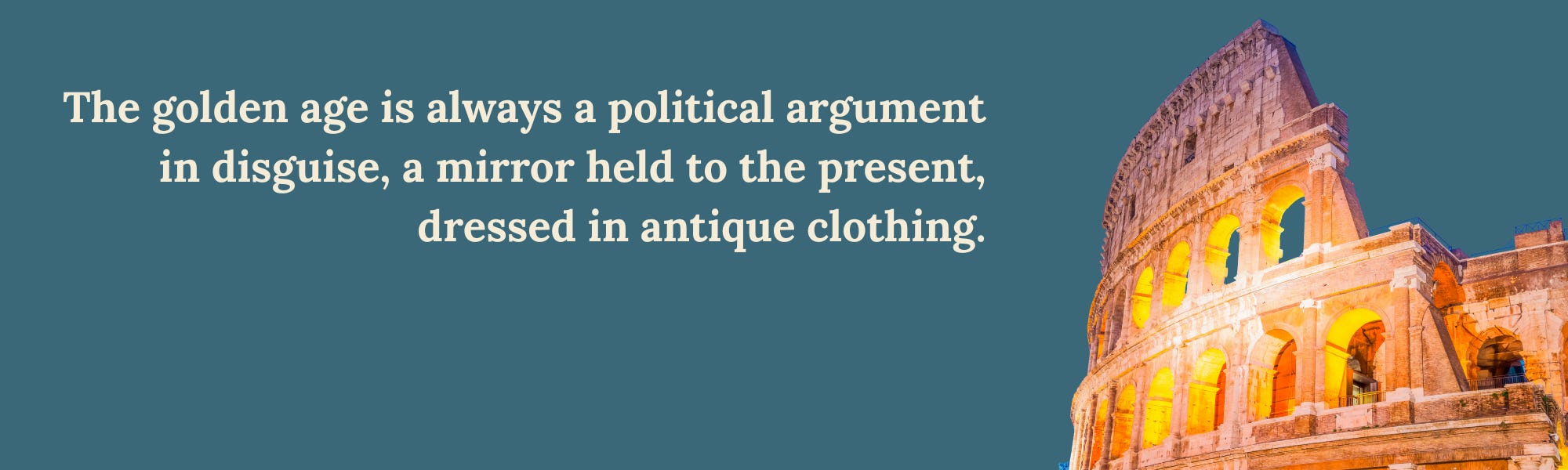
It appears in Hesiod’s Works and Days, where humanity tumbled through the ages of gold, silver, bronze, and iron, each worse than the last. It surfaces in Hindu cosmology’s four yugas, the Aztec belief in successive world-suns, the Norse memory of an Asgard before Ragnarok. The Islamic and Christian traditions speak of a paradisal beginning before the Fall. The Roman poets ached for a republic that was already becoming myth while they still lived. The pattern is everywhere, and it is never merely nostalgic. The Lost Golden Age is always a political argument in disguise.
For world-builders, this is extraordinarily useful material. The myth of decline is not just a backdrop for your setting it is a living force that shapes how your characters interpret history, justify power, and decide what is worth fighting for. Built carefully, a world’s golden age mythology can do more narrative work than any single villain or event.
