Why Cities Form Where They Do
Geography, Magic Nodes, and Divine Intention — the hidden forces that pull civilization into place
The merchants call it the Crossing. It was a flat shelf of land where three rivers met, unremarkable in every way except one: it is the only place for sixty miles where you can ford all three in a single afternoon. There is no fort here, no royal decree, no founding myth. There is only the water, and the mud, and ten thousand people who needed to get to the other side.
Before we ever put a throne in a fantasy city or a wizard’s tower on its skyline, a more fundamental question deserves our attention: why is this city here at all? It is one of the most overlooked questions in world-building, and one of the most rewarding to answer because the answer shapes everything else. The layout of the streets. The character of the people. The smell of the market. The politics of the port.
Real cities do not appear arbitrarily. They are called into being by geography by the pressure of terrain, water, trade, and defense. And in a fantasy world, those same gravitational forces apply, with one critical addition: magic. Whether your setting features ley lines crackling beneath the earth, divine sanctuaries consecrated by gods, or elemental nodes where the veil between worlds grows thin, the supernatural can become a founding condition as powerful as any river crossing.
This issue, we pull the map out flat and study the forces that make a city inevitable.
The Geography of Inevitability
Where the Real World Builds
Urban geography is a well-studied field, and its conclusions are remarkably consistent across cultures and centuries: cities tend to form at points of convergence. River confluences. Natural harbors. Mountain passes. The narrowest point of a strait. These are not coincidences. They are structural advantages, places where the cost of movement drops sharply and the control of that movement becomes enormously valuable.
Rome sat at the lowest fordable crossing of the Tiber and at a cluster of hills that dominated the surrounding plain and were defensive high ground above a navigable artery. Babylon occupied the alluvial heart of Mesopotamia, where the Tigris and Euphrates drew close enough to irrigate an empire. Constantinople was almost comically well-positioned: a peninsula surrounded on three sides by water, sitting astride the only sea route between the Mediterranean and the Black Sea. Geography did not merely support these cities. It demanded them.
Other common founding conditions include: the mouth of a river (where sea trade meets inland routes), the edge of a desert or forest (where frontier traders exchange goods), and elevated terrain with a reliable water source (the classic defensible hilltop). Each creates a different kind of city, with different values, different problems, and different neighbors.
Geography did not merely support these cities. It demanded them.
Terrain Shapes Culture
Here is something world-builders often forget: the land does not just determine where the city is built. It shapes who builds it and what they believe. A city carved into cliffs above a river gorge breeds a different psychology than a city spread across an open plain. The cliff-dwellers learn to think vertically where status measured in altitude, the powerful living high and looking down. The plainspeople learn to think horizontally with influence measured in distance covered, wealth measured in how far a merchant’s wagons can reach.
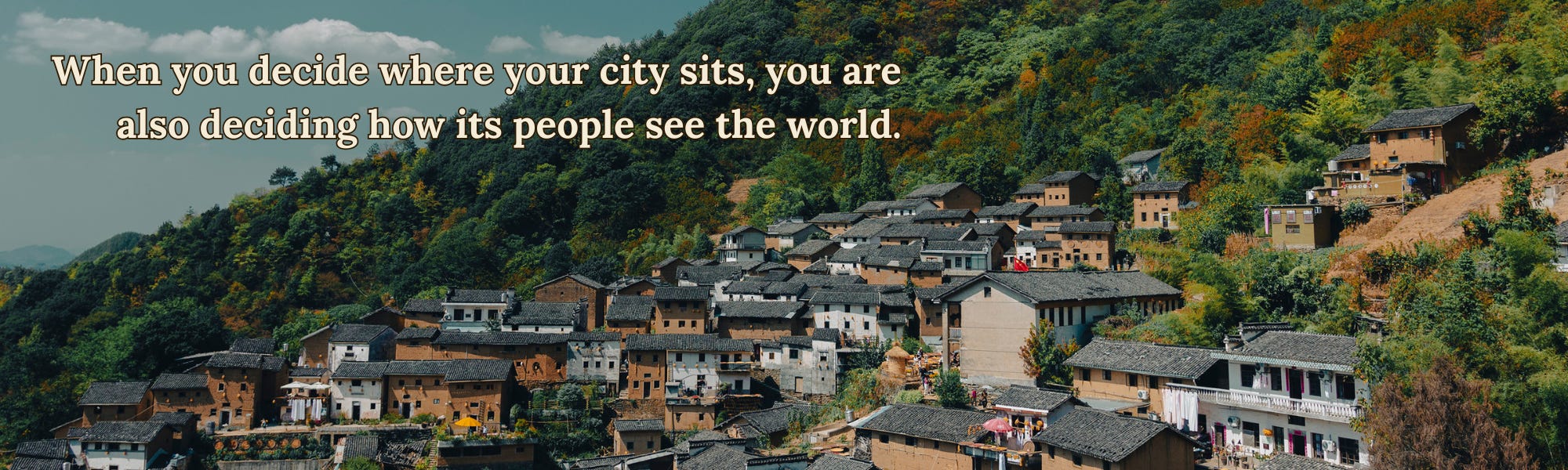
When you decide where your city sits, you are also deciding how its people see the world. That is a gift worth opening slowly.
Magic as Geographical Force
Ley Lines and the Cartography of Power
In many fantasy settings, magical energy flows through the world in patterns such as ley lines, aetheric currents, dragon paths, or spirit roads. These are not merely decorative. Treat them like rivers. A convergence of ley lines is a magical confluence, and just as rivers attracted real-world settlement, magic nodes should attract fantasy settlement.
The question to ask is: who profits from proximity to a magic node? The answer drives your city’s character. If raw magical energy makes crops grow without irrigation, you get an agricultural civilization with deep spiritual ties to the land — and priests who are also land managers. If the node warps probability and makes enchantment easier, you get artificers, enchanters, and a city that exports magical goods. If the node is unpredictable and occasionally dangerous, you get a boom town populated by risk-tolerant fortune-hunters, with a short history and a high mortality rate.
The Roman town of Bath was built around a hot spring that the locals called Sulis. It was a sacred site long before the Romans arrived. They did not dismiss the local belief; they built their baths on top of it and named the town Aquae Sulis. The strategic value and the sacred value were inseparable. In your world, a magic node may have been sacred before it was strategic, or strategic before it was sacred but the two almost always collapse into each other over time.
A convergence of ley lines is a magical confluence and just as rivers attracted real-world settlement, magic nodes should attract fantasy settlement.
Sacred Geography and Divine Mandate
Many real-world cities were founded not at practical sites but at sacred ones — places where a sign was given, a vision received, an oracle consulted. Tenochtitlan, capital of the Aztec Empire, was built on an island in Lake Texcoco because an eagle was seen there perched on a cactus with a serpent in its mouth — a divine sign the Mexica had been told to seek. The location was, practically speaking, a swamp. They built one of the greatest cities of the pre-Columbian Americas on it anyway, because the gods said so.
This is the logic of divine intention, and it is powerful world-building material. A city founded on a divine mandate carries that mandate in its bones. The founding story shapes law, architecture, and civic identity for generations. It gives the city a destiny and a potential crisis if that destiny is ever questioned.
In a world where the gods demonstrably exist and occasionally intervene, divine founding is not mystical but geopolitical. A city blessed at its foundation by a war god is a natural military capital. A city founded at the site of a divine birth or death becomes a pilgrimage destination with all the economic activity that implies. A city built where a god is said to sleep beneath the earth has a very interesting relationship with excavation.
⧉ WORLDBUILDER’S TOOLKIT: CITY FOUNDATIONS
What is the founding condition of your city — river crossing, harbor, ley node, sacred site, or something else entirely?
Who first recognized the site’s value? A surveyor, a priest, a refugee, a predator following prey?
How does the founding condition still shape daily life? Do people still ford the river? Still make offerings at the node?
Has the original advantage ever become a liability? A sacred spring that dried up. A trade route that shifted. A ley line that went dark.
What does your city’s architecture say about its terrain? Do buildings climb vertically or spread laterally? Are they built to impress travelers or to defend against them?
Has any faction — religious, mercantile, or military — tried to claim exclusive control over the founding resource?
What is conspicuously absent from the city that its geography should have provided? The missing thing is often the most interesting story.
If the city was founded on a divine mandate, what happens to civic identity if a later god disputes the original claim?
The Palimpsest City
Layers of Founding
Real cities are rarely founded once. They are founded, abandoned, resettled, renamed, and refounded across centuries with each layer leaving a residue in the streets and the stories. Archaeologists call this a tell: a mound built up from accumulated occupation, where each generation’s ruins become the next generation’s foundations.
The city of Jerusalem has been continuously inhabited for at least five thousand years, destroyed and rebuilt more than once, and claimed by multiple faiths as the site of creation, sacrifice, and divine promise. Its geography , a ridge between two valleys with a reliable spring, made it worth fighting over. Its sacred history made it worth dying for. The two reinforced each other across millennia.
For the fantasy world-builder, the palimpsest city is a treasure chest. The ruins beneath the current city may conceal a former magic node, now dormant or depleted. The streets may follow the outlines of a vanished culture’s sacred geometry. The grand cathedral may be built on the foundations of a temple to a god the current religion considers a demon. These layers are not just flavor. They are the source of conflicts that feel genuinely ancient, because they are.
What Remains When the Advantage Disappears
Sometimes the founding condition vanishes, and the city persists by sheer inertia, scrambling to reinvent itself. The harbor silts up. The mine runs dry. The trade route shifts when a new mountain pass is discovered. The magic node goes quiet.
These cities are among the most interesting to inhabit narratively. They are places in denial, or in mourning, or in frantic adaptation. Their self-image has not caught up with their reality. The merchants still call themselves the masters of the sea, even though no deep-keeled ship has entered their harbor in a generation. The priests still perform the rituals for the magic node, even though nothing has happened at the node since the Sundering.
The gap between what a city believes it is and what it actually is becomes the fertile ground where drama grows.
The Human Dimension: People Who Make a Place
The First Arrivals
Every city starts with someone who stops. A scout who decides the ridge is defensible. A trader who builds a warehouse. A priest who declares the spring sacred. These first arrivals are not building a city but a waypoint, a camp, or a shrine. The city comes later, when enough people follow.
Think carefully about who your first arrivals are. They set the cultural DNA. A city founded by refugees carries different values than one founded by conquerors. A city built around a monastery develops different architecture and different intellectual traditions than one built around a fortress. The founding population’s needs, fears, and beliefs get baked into the city’s infrastructure, and infrastructure is almost impossible to fully erase.
The People the City Makes
Cities do not merely reflect their founders. Over time, they create new kinds of people. The urban environment, the density, the anonymity, the constant proximity of strangers, produces characteristics that rural life suppresses: cosmopolitanism, tolerance for difference, entrepreneurial risk-taking, a certain detachment from communal obligation. Sociologists call this the urban effect, and it has been documented in cultures from ancient Ur to modern Tokyo.
In a fantasy world, this effect is amplified by magic and non-human species. A city that sits on a ley node may gradually affect the people who live above it giving them strange dreams, unusual aptitudes, or a faint luminescence visible only in darkness. A city built on a divine mandate may produce citizens who are, after generations of proximity to sacred ground, subtly different in body or belief from their rural cousins. The city does not just shelter people. It changes them.
That is, in the end, the deepest reason to think carefully about why your city is where it is. It is not just a matter of narrative plausibility or worldbuilding rigor though it is both of those things. It is because the founding conditions of a city are also its character. The city is a machine for making a particular kind of human being, and the machine was designed, consciously or not, by the land it was built on.
Get the geography right, and the people will follow.

